Britain’s New Envoy on Mongolia’s Democratic Promise
Britain’s new envoy in Ulaanbaatar wants a navy-blue deel, a week in the Gobi and a world that builds bridges rather than walls. Over shisha and chicken skewers, H.E. Edwin Samuel talks Chinggis Khaan, Rio Tinto, and why “neutral” is an old-fashioned word.
Shisha with the Ambassador
The interview did not start well, and Edwin Samuel would be the first to say so. The lighting was unkind, the mood was flat, and the next table had the appetite and acoustics of a wedding party. For a while it looked like the kind of evening diplomats file under “courtesy call”.
Then our waiter, Ilya, a Russian who spent eight years in Turkey before landing in Ulaanbaatar, mentioned a place across town where you can smoke shisha, eat dinner and play with real snakes. The Ambassador brightened visibly. “There you go,” he said, “You said this was a boring interview. This is getting better.”
We had begun, as Mongolia Rising always does, with the easy ones. Favourite colour: navy blue. Favourite thing about Mongolia: the deel, without a flicker of hesitation. “Genuinely one of the best national costumes. I’m not just saying that,” he insists. “It’s basically the original Jedi Knight outfit.”
His own is being made by Michel & Amazonka, though the fittings have involved some negotiation. “I’m not very impressed with all the frills. I said, I’m a very plain kind of guy. Keep it conservative. Think Darth Vader.” Asked to guess the colour, the table answered in chorus: blue. “A bit of black, maybe,” he conceded. Black, it turns out, has a diplomatic function. “When you have to play the bad cop, black is the colour.”
It is a fair summary of the man. Samuel is a former barrister who dresses like a Sith lord in waiting, talks like an Oxford tutor, and cannot, by his own cheerful admission, stick to the subject.
From prehistory to the in-between place
Samuel’s CV reads like a sampler of respectable institutions: Lincoln’s Inn, HSBC, the European Commission. When did he work at the bank and in Brussels? “Prehistory,” he says. “1999.”
The bulk of his career, some 12 to 15 years, was spent in the Arab world: Damascus, Riyadh, and four years in Dubai as the British government’s Arabic-language spokesperson. I asked what that period taught him and how it relates to serving here. He gave the answer of a man who has spent too long being quoted. “They paid me to do it and the King appointed me. Am I missing something? That’s the relationship. I’m a servant of the British government.”
So what draws a Middle East hand to Ulaanbaatar? “The fact that it’s in the middle. It’s an in-between place,” he says. “And countries that are in between need to stick together.” Britain and Mongolia, he points out, are both former imperial powers. “It’s not easy coming to terms with the fact that you don’t call the shots any more.”
Both also suffer from reputations that outrun reality. “People have stereotypes about Chinggis Khaan and Mongolians in the same way they might about Henry VIII and Britain. There were benefits in being thought to be fierce. But it doesn’t serve us any more.”
On the Great Khan, the former barrister mounts a spirited defence. “The idea that he destroyed everything in his wake is only partly true. He used fear and conquest as a weapon. But he was also a great proponent of diplomacy, of intelligence, of freedom of religion. He even decided that writing would be a good idea. That’s quite enlightened for somebody people call a barbarian.”
It is, he suggests, a professional specialism. “You could argue that in my diplomatic life I specialised in the misunderstood. In many parts of the world, the UK, for many good reasons, is thought of as a baddie because of the colonial past. I’m not saying everything we did was right. I’m saying there’s more to us than that. And that’s probably true of Mongolia too.”
The myth-busting extends to Mongolian men. One of his closest Mongolian friends in Oxford spent a spell as a house husband while his wife went to business school. “I was very impressed with the way he brought up his children.” Mongolians, he adds approvingly, also defy the regional stereotype in one crucial respect. “People here say no. How many other Asian cultures do you know where people actually use the word no?”
Tinned tuna and fair deals
Dinner, meanwhile, was becoming a diplomatic incident of its own. The Ambassador confesses he is “finding it difficult”. His go-to meal? “Tinned tuna from London.” Homemade dumplings pass muster; fresh chicken, he reports, has proved impossible to find anywhere in the city.
On to business. Trade, he insists, is only part of a bigger picture. “The truth is this is about strategy. We live in a dangerous world where we all have to make our own way. But it’s about friends. And of course trade is part of that.”
Mining is the elephant in every room. “Many people forget that Rio Tinto is a British and Australian company. I don’t answer to Rio Tinto and I don’t answer for them,” he says, with the care of someone who has rehearsed the line. “But in a world where lots of state-controlled companies are buying in, northern European, Anglo-Saxon ideas about accountability are a good thing. That doesn’t mean I agree with everything Rio Tinto tells me.” Mongolia, in his view, made a good choice “getting into bed with entities that live by, for want of a better description, British values”.
He is keen that the relationship is about more than one copper mine. “We want to make sure everybody gets a fair deal, and in particular that Mongolians feel joint ventures with British companies are a good thing.” Copper alone, he argues, will not carry a nation. “The exam question for any resource-rich country, whether it’s Mongolia, Australia or Saudi Arabia, is how you diversify to provide quality of life and jobs. For a culture built on herding or holding assets, that’s a hard transition. But young Mongolians have shown themselves to be pretty entrepreneurial.”
Is the current Oyu Tolgoi arrangement a fair deal? He declines the bait. “I don’t know enough about it. All I know is that if Mongolia wants more investors who play by the rules, it needs to make sure democracy is not seen to be unstable. That’s true of all democracies.” Then, with a grin: “Britain is hardly in a place to lecture. We’ve had seven prime ministers in the past ten years.”
Where, beyond mining, are the realistic British opportunities? His shortlist is surprisingly contemporary. Gaming, first. Then data centres, where Mongolia’s cruel winters become a competitive advantage. “It’s a cold country, and that means the energy and water needed to cool data centres will be much less.” And renewables. “I know it’s predictable to say it, but you don’t need to be a Martian to see there are energy issues. Whether you’re Spain or Mongolia or Britain, you want diverse, clean options.” Mongolia’s famous blue sky, he adds, is “quite a good recipe for year-round solar”. And since most of the country is uninhabited, “it won’t be in anybody’s backyard. You might even export some of that energy.”
What about the Mongolian companies now weighing listings in London? “Going public is a great way to release capital, and Britain’s capital markets are known for it,” he says. “It also introduces accountability. Once you’re publicly owned, you have to issue audited accounts, and higher transparency is a good thing.” Investor interest, he argues, is itself a verdict. “These people are not charities. They realise something is going on here.” The real challenge, he says, is keeping those ethics of accountability and transparency alive in the next generation.
Bridges that can carry traffic
Having studied in Britain and at the Lee Kuan Yew School in Singapore, I suggested that British education enjoys a certain global prestige. He accepts the compliment with lawyerly caution. “I think it’s up there with the others. But I’m biased.” Britain, he says, is “much the richer” for its international students, and the country’s position, tied to Europe but open to everywhere else, makes the experience genuinely international.
His particular pride is the Chevening scholarship. “There aren’t many of them, and they’re not as rich as some of the American ones. But I can’t think of a Chevening scholar who’s come back a poorer person for it.” Will the programme grow? “It will be steady. It’s one of our best soft-power tools, but it’s not there to brainwash.” The constraint is money, not talent. “We’ve got enough applicants. I would just like more scholarships.” Some are co-funded with the Mongolian government, which he reads as proof of value. “It’s not just about being friends. It’s about creating an international intelligentsia.”
A British university campus in Ulaanbaatar? “I would like that. But in the end, universities are not arms of the British government. People vote with their feet.” Partnerships in education, he argues, build “an international consensus about what a global good is”, at a time when globalisation is under threat. “People seem more interested these days in building walls than bridges. As a diplomat, my job is to build bridges that can support weight and traffic.”
On English, now the country’s priority foreign language, he is characteristically oblique. “Whoever decided English should be an official language in Mongolia understood that it was about opening the door to alternative ways of doing things.”
Tourism brings out the romantic. One of his first jobs was teaching English; another was shepherding American school groups around Europe as a tour manager. “I learned as much from them as they learned from me. The world is much better for exposure.” But he refuses to sneer at the young. “It’s easy to parody Gen Z. But from their own iPads they are pretty international. There are people who have spent ten years playing online games with people from the other side of the world. Somebody of my generation likes old-fashioned travel. But the jury is out on Gen Z.”
What should Mongolia sell to British travellers? “Modernity with resilience,” he says at once. “On the one hand, Mongolians are modern, fashionable, technologically savvy. On the other, boy, can they put up with hardship in a way most of us can’t.”
Then, in the oldest diplomatic manoeuvre of all, he turned the argument on the interviewer. “Look at you. Educated in the UK and Singapore, highly fashionable, a great hairdo. But I don’t think you would wither if I put you in a ger.” I told him the countryside is my OG. “There you go. Appearances can be deceptive. That ability to persist and endure is, in the current world, a scarce resource. And that’s admirable.” He paused to savour the word. “Admirable. A great word, so rarely used in English these days. Write that one down.” I have.
Where would he send a British friend with a week to spare? He admits he has barely left the capital. “I’ve had a taster. I know enough to know that’s not really the countryside.” He is wary of generalising. “Like a lot of countries that are both rich and harsh, there’s a lot of regionalism. It’s too easy for foreigners to say everybody is the same. I know that from Arabia.” His own first trip will be to the Gobi. “I’m a desert person.”
His one worry is the roads. “For a country as rich as Mongolia, sealed roads could probably be sorted out quite quickly.” I pushed back: Mongolians are wary of mega-projects, where the budgets are vast and public trust is thin. “It’s a fair thing to say,” he concedes, and reaches for a story. A Saudi friend who came to Ulaanbaatar for the COP told him: “These guys are lucky they haven’t taken it all out of the ground yet. We took it out before we were ready.” The result, Samuel says, was generations left unemployable. “So you’ve got a head start. You can learn from others’ mistakes. Infrastructure that serves the people, sealed roads, hospitals, is part of showing that wealth is not for the few but for the many.”
Impartial, not neutral
The Norway comparison is never far away. “I don’t want to be stereotypical, but look at Norway. A harsh place, a small population, a huge wealth fund. They used it well, for education, for people when they’re old. And they made sure they had good defence and good friends. Unlike Sweden, they decided they were going to be on a side.”
That brings us to the phrase every Mongolian diplomat learns in the cradle: the “third neighbour”. Squeezed between Russia and China, does Mongolia’s democracy feel the pressure? “Democracy around the world is under pressure,” he says. “Many people will tell you democracy is unstable and unsuitable. For all its shortcomings, it is less stable than a system where somebody just dictates. But with dictators, you can be lucky like Lee Kuan Yew, or unlucky, like Saddam Hussein.”
He returns, with evident relish, to Britain’s turnover in Downing Street. “People say to me, oh dear, Britain keeps changing its prime minister. I say, well, at least we can change them when we want to. Without bloodshed is the main thing. Friends in the Arab world tell me that when they see a British prime minister resign, they can’t believe it. They say in our country there would be blood.”
Critical minerals, he insists, are not just a Western obsession. “It’s everybody’s strategic priority. Like oil in its time, they are the key commodities for what we need next, whether that’s data centres or chips. And like all key commodities, they need a free market. There’s a real problem with countries, people or organisations that want to hoard them.” Hence London’s pitch. “The London Metal Exchange isn’t perfect, but it has kept its position for a reason. We have the rule of law. You have a contract; you can sue if somebody doesn’t deliver. And the judiciary is not connected to the people in power.”
Can Mongolia realistically supply Britain and its partners? “It can supply the world. It doesn’t have to be just one bunch of people. Mongolia is its own country and it makes its own decisions.” The lesson he brings from the Gulf is about plumbing, not geology. “You need the structures, the maturity and the systems, so that when these valuable things come out of the ground they are not hoarded by any one person, and what comes from them goes into diversification.”
Is Britain willing to help? “Yes, because we have the legal and commercial infrastructure to do it. The LME happens to be in London not because Britain had an empire, but because people respect English law. If you have a joint venture, the other person won’t run off with the money. If they do, you pursue them.” It is the same logic, he notes, behind Mongolia’s interest in an international financial centre. He cites Dubai and Singapore as experiments that “understood the value of common law systems, or English law for shorthand”, though he is careful to add that Mongolia need not copy anyone.
Then the question every foreign envoy here must eventually field: is Mongolian neutrality sustainable? “It’s difficult for Britain to answer, because we haven’t had to live in the same situation. But Britain has long had to balance different powers. We’re Atlanticists and we’re Europeans. Whatever happened with Brexit, we’re still European.” He then gently dismantles the premise. “Neutrality is quite an old-fashioned term. It means you don’t take a stance. Impartial is different. Impartial means you can take stands on things that matter to you, while not taking sides.” Beneath the semantics lies the conviction he returns most often. Mongolia is free, and a free country must have the freedom to choose: its partners, its path and the stands it takes.
On Ukraine, where he knows opinion in Mongolia runs strong and varied, he chooses his words with care. “Whatever Ukraine did right or wrong, the idea that suddenly you can be taken over is bad news for small countries. If Britain is known for something, it’s sticking up for the underdog in dark times. I guess that’s part of the Churchill identity.”
Predecessors have called the embassy “small but high-impact”. He is generous about the most recent of them. Fiona Blyth, who he says brought “intelligence and glamour” to the post, a combination that sets a high bar for any successor. He prefers to think of it as a small jewel. Success in three years, he says, means helping Mongolia’s foreign policy and getting the country “more of the limelight as a successful democracy”, whether at the UN or in peacekeeping. “I know these things are not that important to average Mongolians, but they matter on the world stage.” And what 3.5 million Mongolians think of Britain matters to him in turn.
Then comes the line he has clearly polished. “Mongolia reminds me a lot of West Berlin. It’s cool, it’s its own thing, in the middle of places that don’t do it the same way. That doesn’t mean demonising the others. It just means doing it your own way. We admire that. We want to see Mongolia get its place in the sun,” he adds, “even though it is already much sunnier than Britain.”
Heavy metal and the bill
If soft power has a soundtrack, for Samuel it is The Hu. He first met the band at Naadam in London, where his Mongolian opposite number invited him to the embassy on one of the hottest days Britain has endured. “On one hand they look like they’ve just come out of Chinggis Khaan’s army. On the other, here were classically trained musicians playing these instruments incredibly skilfully, and not at all aggressively.” He did not understand the lyrics, which some say come straight from Tengrism, “so in some sense I was deprived of the real meaning”. What stayed with him was the fusion of modernity and tradition.
The band invited him to their concert in Ulaanbaatar on the day he arrived, which happened to be his birthday. As British ambassador he had been given very, very VIP tickets. “Apart from anything, I had no idea what you wear to the VVIP section of a heavy metal concert. So I turned up dressed like some middle-aged professor.” His verdict, which he invites us to quote: “These are guys you want to be friends with. You don’t want to be enemies.”
It is, perhaps, the best summary of his own diplomacy: look the part, play it skilfully, and make friends rather than enemies. Friendship, in his telling, is never a form of ownership. Mongolia is free, and its freedom includes the freedom to choose. Britain’s task, as he sees it, is simply to be worth choosing.
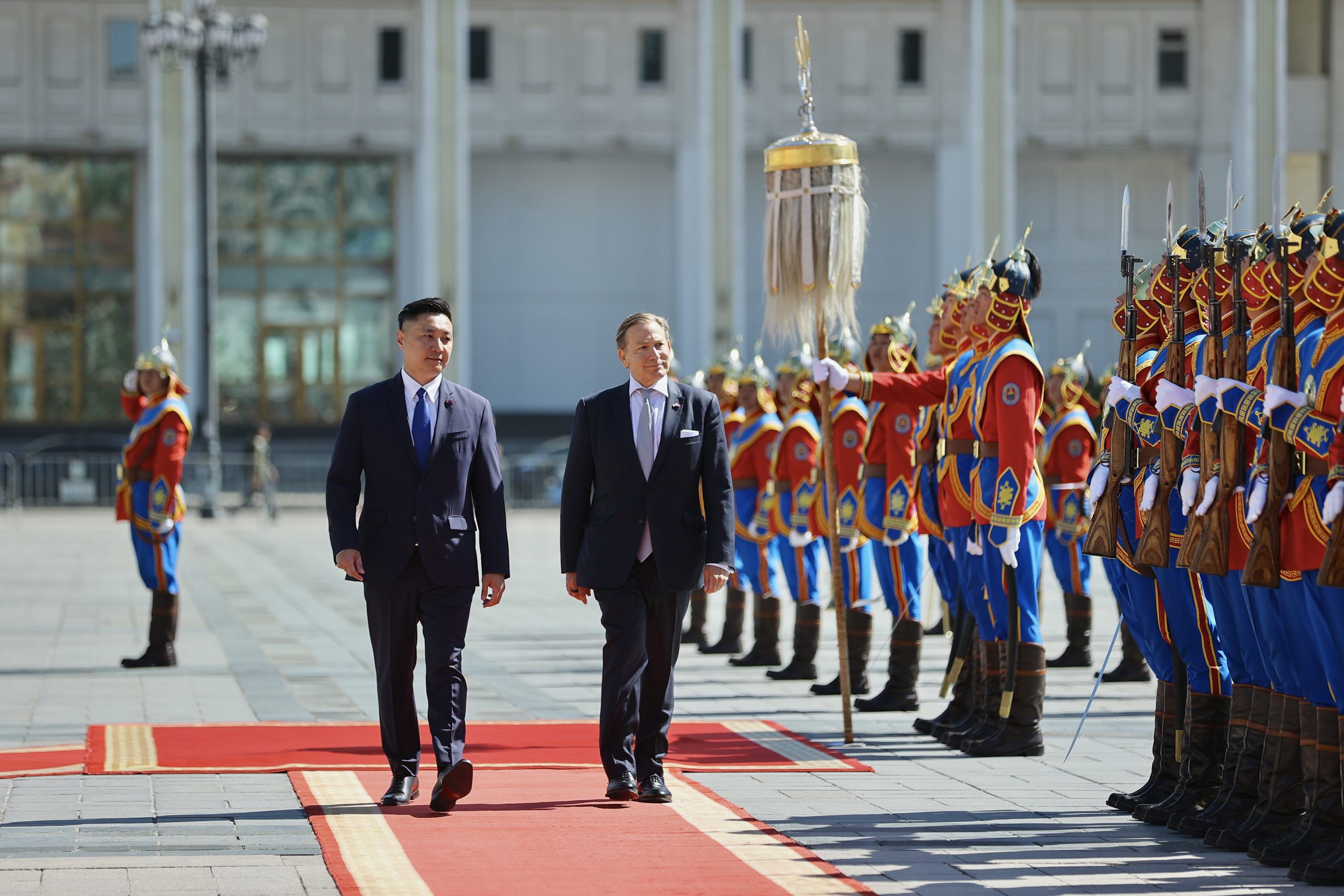
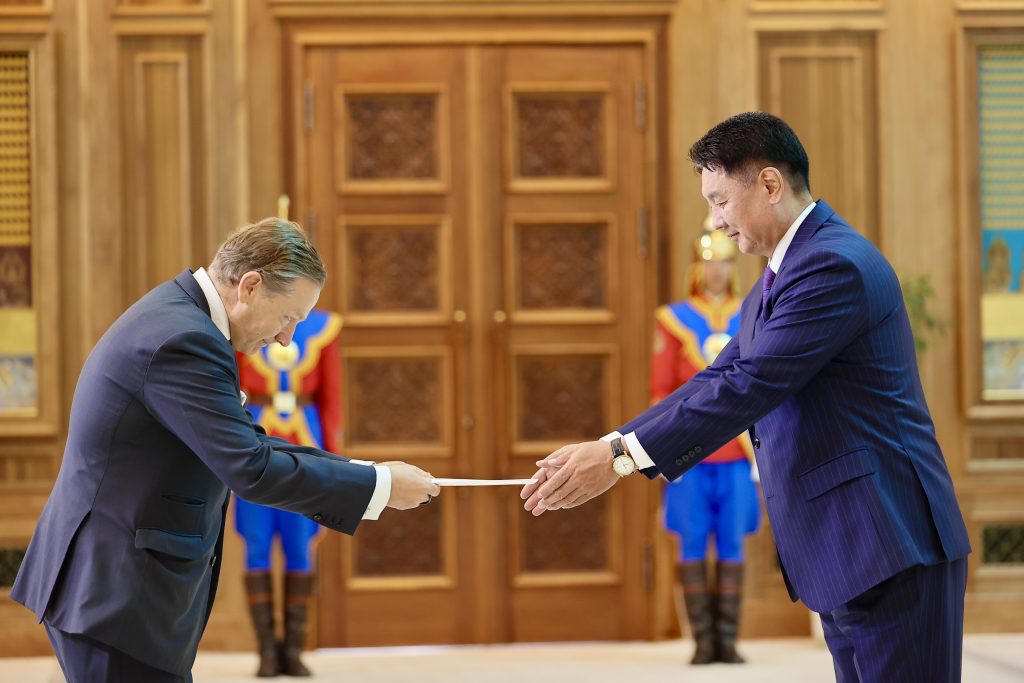
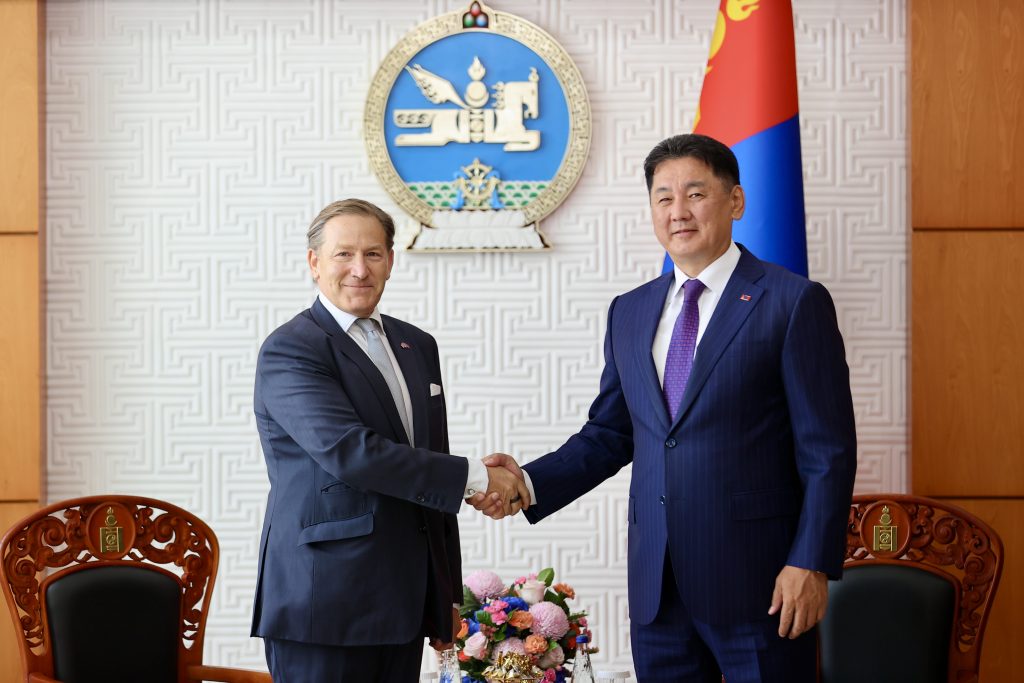
Edwin Samuel is His Majesty’s Ambassador to Mongolia. He presented his credentials on 10 August 2026.
Leave a Reply